Humpback whales and the Gold Coast's Humpback Highway
One of the greatest natural spectacles on Earth happens just off the Gold Coast every year.
The distance of the great humpback whale migration is second only to that of the tiny Arctic tern, a 113g bird that follows a zigzagging route from Greenland to Antarctica.
Humpback whales, which are found in all oceans of the world, migrate annually from their summer feeding grounds in the polar regions to their winter breeding grounds near the tropics. The Southern Hemisphere humpbacks make an annual migration of approx. 11,000km return. Here on the east Australian coastline, we are able to witness this awe-inspiring migration between May and November, the peak whale watching season on the Gold Coast.
Who comes past first
The first whales we usually see heading north are the females travelling with last year's calf, known as a yearling. Following them are the juveniles of both sexes, the sub-adults are next and then the fully grown adults. The pregnant females are the last to leave Antarctica. On their return trip it is slightly different, but we can share more about that when you are onboard.
The best time for whale watching tours on the Gold Coast
A lot of people ask us, "when is the best time of year to swim with the humpbacks?" Our answer is a beautiful moment that occurs during the southbound part of the whales' annual migration.
On this stretch of the coastline, the whales display an incredibly inquisitive switch in behaviour known as "a mugging". The whales often stop swimming, turn and swim straight over to the boat to check us out. Some pods may stay watching us onboard for up to an hour. Some may even display their marine ballet talents to our delight.
An increase in this behaviour always takes place during late August and September, however it can happen at any time during the whale watching (migration) season from May to November. Our whale watching season guide has more on timing, and the best time to swim with whales is August to October.
The mystery of whales
There will always be an element of mystery about whales. They spend more than 70% of their lives under the water (sometimes at depths of 100 to 200m). It is natural that they inspire enormous curiosity and awe when they do appear with us at the surface.
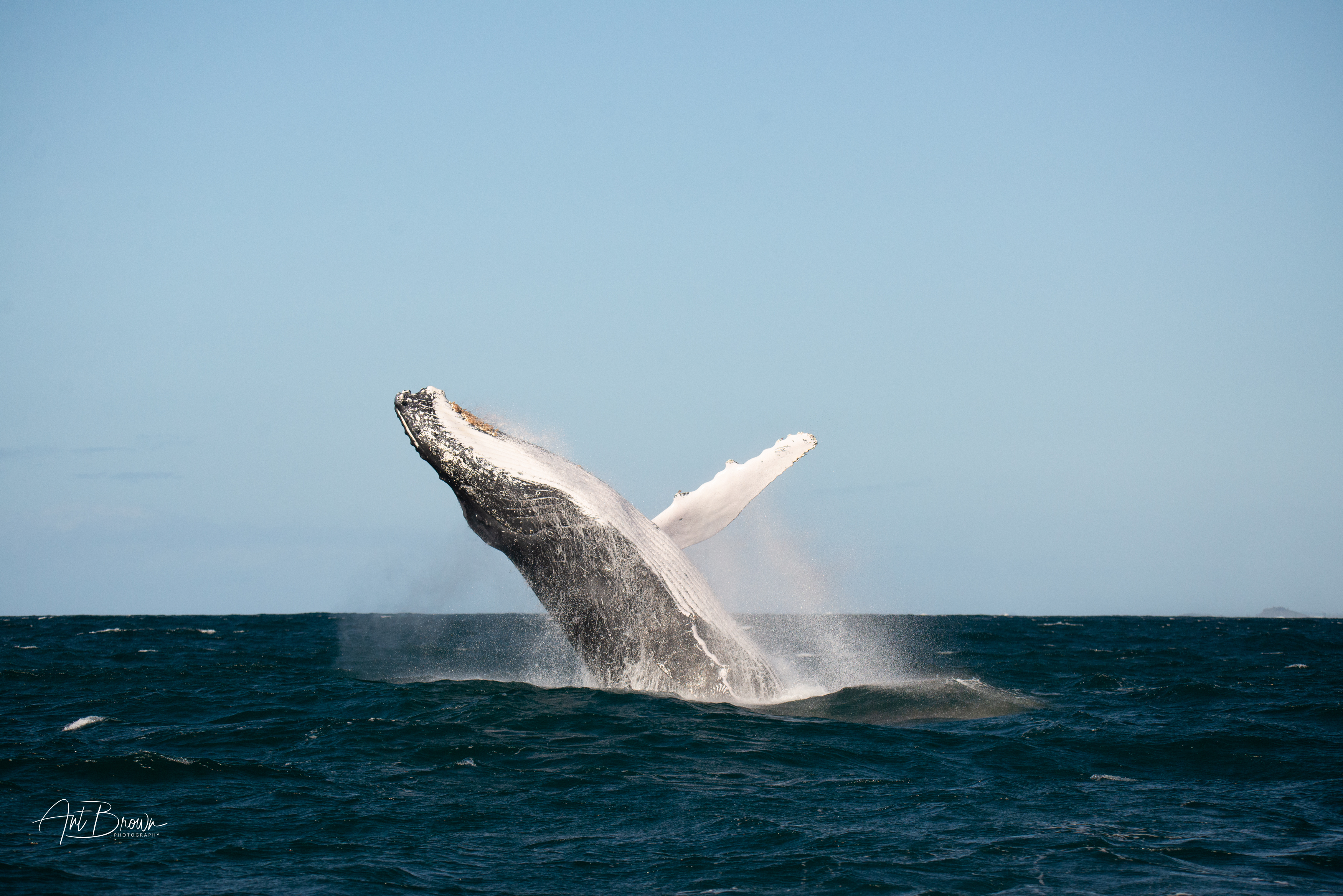
Knowing a few statistics about humpback whales will not prepare you for the full surprise and amazement of seeing a 16m, 40 tonne mammal completely lift itself out of the water, twirl, wave and then crash back into the sea, sending spray 10m+ into the air.
When a whale surfaces, the simple act of exhaling results in a 'blow' of spray, and the air shoots up to four metres high. In doing so, it empties 90% of the expired air in its lungs in less than a second. The whale's lung capacity is approx. equivalent to the volume of a small car. When they breathe in and dive under the surface, they can stay submerged for up to 30 to 40 minutes. Generally, here off the Gold Coast, they submerge for between 3 and 10 minutes. We call this their 'down time'.
Patterns, sight and nursing calves
Each humpback has its own patterns on its pectoral fins, belly and the underside of its tail. Humpbacks are believed to see just as well above the water as below (more on whale vision). The Gold Coast Bay has also become a birthing and nursing ground: humpbacks that once calved mainly in the Great Barrier Reef are now calving about 1,000km further south, close to the coast for protection from predators such as killer whales (read the nursing ground story).
Learn more on board
There is so much information about whales that we are excited to share with you, but we can't fit it all into one article. Onboard with us at Cooly Eco Adventures, you will learn much more about the magic of the whales and how together we can continue to protect them and our ocean for future generations.
Join us for an experience of whale watching here on the Gold Coast you won't soon forget.
Ready to see them for yourself? Have a look at our whale watching tour on the Gold Coast.